Monday, 14 November 2016

Progress of the Barnes pond cygnets - July/November

I like visiting the Barnes Wetland Centre, but do not manage to go there as often as I would like.  On my way there in early July I stopped off at Barnes village pond and took some photographs of the swan family there.  There were four fluffy grey cygnets and one white fluffy cygnet, together with their parents.  There are more photographs of the swan family in one of my previous posts.

The photograph of two contrasting cygnets was taken on my way to the Wetlands at about lunch time.


The photograph of two contrasting cygnets eating grass near the pond was taken on my way back to Barnes Bridge station in the late afternoon.  I love their little fluffy wings.


It was a sunny day yesterday so I decided to go over to Barnes again, but I did not manage to leave the flat until mid-day and, therefore, arrived in Barnes later than I had planned.  The swan family were swimming over to the side of the village pond and I managed to take some photographs of them.  It was about four months since my last visit to the pond in Barnes and there were only three cygnets altogether, instead of five.


A parent mute swan got out of the water and flapped its wings and seems to have a large leaf stuck to its tummy.  I do not know enough about swans to know if this is the male or the female.  It looks very large in this photo, so I am guessing that it might be dad.  There are two brown/white patchy cygnets and one pure white one, so I was pleased to see that the pure white cygnet had survived.


This is a photograph of one of the "normal" coloured cygnets.


In this photograph there is a cygnet with the normal brown and white markings and the pure white cygnet.


This is the other brown and white cygnet.


The white cygnet looks just like its parents, except that the beak is a lighter colour.


The swan family swam over to the other side of the pond, where a young family was feeding the other ducks, black-headed gulls and pigeons.  The swans were very keen to join in.


It was pandemonium!  The black-headed gulls were flying everywhere, but the swans and cygnets were being very patient.  In this photograph, the white cygnet is next to a parent - so the contrast in the colour of the beaks can be clearly seen - and, of course, it is still much smaller than a fully-grown swan.  The cygnets are now nearly there though!


Monday, 31 October 2016

Geese, swans, gulls, white doves and fancy hens along the River Yare in Norfolk

 At the weekend I visited Thorpe St Andrew, which is in the outskirts of Norwich.  It is a lovely area and the house I stayed in was not far from the River Yare.  On Saturday afternoon we walked to the river to have a look at what was going on.  There were lots of boats, of course, and some wildlife.  In the photograph below there is a Mute Swan in the distance and a gang of Greylag Geese.


The Greylags were having a great time and probably hoping we had some food for them - we did not, so they eventually lost interest in us.


On the river bank was a gang of Black-Headed Gulls - with white heads!  Can somebody tell me when they get their black heads back?


Then, swimming along on the other side of the river, were a couple of young Mute cygnets - now nearly grown up and looking very sophisticated.


They were followed by a parent, presumably mum Mute Swan, who was keeping a beady eye of
them.


We stopped for a short rest in the garden of a pub that overlooked the river.  There was a shed in the garden containing several fancy/unusual/exotic chickens/hens.  I don't know anything about hens or chickens but, having looked on the internet, I believe they may be Cochin hens.  Anyway, whatever they are, it was very interesting seeing them.


On the walk back along the river, I then took a few photographs of some white doves that were also on the river bank.  I love doves and, over the years, have collected several Falconware ceramic items that feature doves and dovecotes.


Then, on the other side of the river, I spied their dovecote!


It was a very interesting walk and made a change from taking photographs of the wildlife in London's parks.

Thursday, 27 October 2016

Captive and wild birds in the Barnes Wetland Centre

I have been to the Barnes Wetland Centre (London Wetland Centre) several times over the last few years and always have an amazing and very interesting time there.  There are several large lagoons with bird hides, but often the birds on the water are much too far away and can only be clearly seen with very strong binoculars.  They are impossible to photograph unless you are wealthy enough to own a very large camera with a strong zoom lens.  Mine is only relatively tiny, so I have to resign myself to taking photographs of the reserve's captive birds.

The photographs below were taken during one of my walks round the reserve in March 2016 - I have taken so many photographs over the last couple of years and just not had time to write about them straight away.  I just don't know where my time goes, but it definitely runs away very fast!

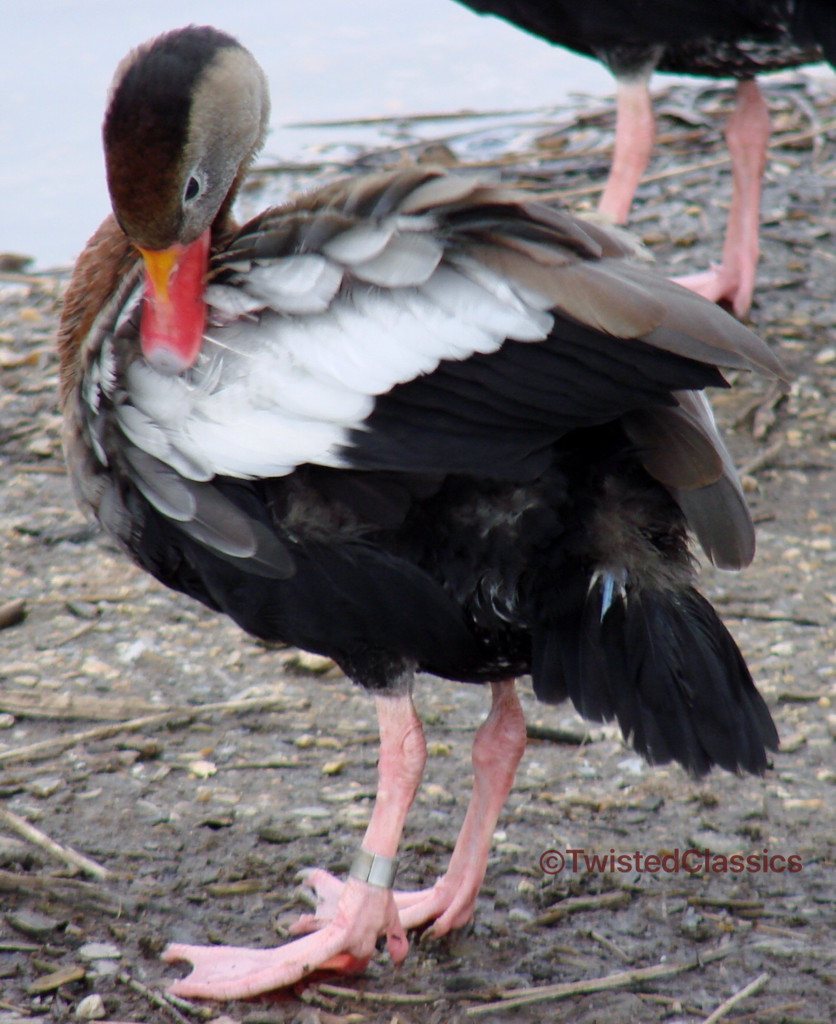
These are some Black-Bellied Whistling ducks in preening mode.


These are Fulvous Whistling ducks in swimming mode.


These are 2 Southern Screamers in resting mode


and standing mode


The birds in the photograph below were on the wild side of the Wetland Centre and were swimming around in separate small ponds on the site.

Here is a Tufted drake


and his partner, a Tufted duck


 This is a mummy Tufted duck with 4 Tufted ducklings


 I presume this is a Mallard duckling that appears to be looking for bugs on the reeds.


Captive or wild, the birds at the Centre are amazing and I often find it hard to drag myself out of the place in order to go back home!

Friday, 7 October 2016

Two Leucistic Greylag Geese

In July I took my camera for a walk in the park.  I love wandering round the lake and seeing if I can spot any unusual water birds.  This time I came across a couple of Greylag geese with leucism - where there is a loss of colour in the feathers, which go white.  One of the geese was almost completely white, with just small patches of brown, and the other white and brown.

I read on the internet that leucism is a condition where there is a partial loss of pigmentation in an animal, resulting in white, pale or patching colouration of the skin, hair, feathers, scales or cuticle, but not the eyes.  Unlike albinism (where the eyes are pink), it is caused by a reduction in multiple types of pigment and not just melanin.

The first Greylag that I came across with this condition was on the path, mingling with lots of Canada geese who were being fed unsuitable food by some tourists.  It was not getting much of a look-in, with most of the bread going to the other geese.


 It eventually gave up and went for a swim in the lake.


In this photo, the leucistic Greylag is in the centre of the photograph, with two Canada geese in the background.  In the foregroud is another strange-looking goose, which I believe may be a cross between a Bar-Headed goose and a Canada goose.


The leucistic Greylag is now back on land and looking for food from the tourists again.


The next Greylag with leucism that I saw was swimming along with a normal Greylag companion.  This time the goose is more patchy with a mix of white and brown feathers.


I think that it looks attractive with its brown head and patchy brown feathers on its back and sides.


I have to say that seeing the two leucistic Greylag geese and the Bar-Headed/Canada goose hybrid made it a more interesting walk in the park that day.

Thursday, 6 October 2016

Birds seen on a walk round the Serpentine and Long Water in Hyde Park and Kensington Gardens

Whenever I have the time, I love taking my camera for a walk in the park.  There are several to choose from in London and, sometimes, I have great difficulty deciding between them.  Battersea and St. James's are the nearest and I can easily walk to eithe , followed by Hyde Park, with Regent's Park being slightly further away - but both of these are easily reached by underground or bus.  I never visit Green Park as there is no lake and I just love looking at all the water birds, so there is no point in going there.

This time, towards the end of August, I chose to walk round the lake in Hyde Park and Kensington Gardens.  I went by underground to Hyde Park Corner and went into the park at the nearest entrance from the station, strolling through the flower garden, past the Dell and up to the lake.  I began my walk along the Serpentine after passing the cafe that is at the end of the water.

The first interesting water bird I saw was a sweet and strange looking goose.  I believe that it is a hybrid Canada/Greylag-mix.  I think that it has a gorgeous face.


Then I came across a young Egyptian goose, which was swimming very quickly near the edge of the lake.


Following this, I saw a female Tufted duck with a duckling.  Unfortunately, they refused to pose nicely together so I had to take separate photographs of them.

Here is mum:


and here is the baby:


The Serpentine is a boating lake and is often covered with Pedalos.  There were plenty being used on it when I was there.  The strange-looking building at the end of the lake is the cafe where I started my walk.  The Shard can be seen in the distance, along with tall office buildings, reminding me that I was in London and not in the country!


There is another cafe in the park, by the swimming Lido, and here I found a cross-looking heron being stared at by a Canada goose.


The two lakes, Serpentine and Long Water, are dived by a road/pedestrian bridge.  Now the lake is reserved just for wildlife and no Pedalos are allowed along it.  It is very peaceful on the lake and there are not many places where the water can actually be seen as trees, shrubs and reeds line most of the banks on either side of the Long Water.  Below is the view across the lake from one of the few areas at the edge of the lake, where a couple of swans form a tranquil country scene in front of a willow and some wild flowers.


After that, I came across a tree-lined path where tourists are always to be seen feeding, or attempting to feed, the green Ringed-necked Parakeets.  Here three of them are deciding whether whatever is being offered is worth a flight.


At the next open area along the Long Water, there are some posts.  Here I came across a couple of Egyptian geese doing a balancing act.


Also, there was a speckled Black-headed gull swimming backwards and forwards - hoping for someone to offer it something that was worth eating, though I think the birds in the park will eat almost anything that they can find.


On the other side of the Long Water, I came across a Magpie hopping around in the grass.  I think, it too, was waiting for someone to feed it.


Back past the bridge and near the little island that is on this side of the Serpentine, I came found a parent Great Crested Grebe with two chicks.  A Canada Goose is standing in the water near the island and giving them a once over with its beady eye.


They swam away from the goose and a third chick joined the group.  I love their stripey heads and fluffy little bodies.


Standing on the island was a Heron and a Greylag goose, which was having a great preening session.


At the other end of the island, a Cormorant was standing on a post, drying its wings.


Another Cormorant was nearby wetting its wings and having a great bath!


Back out in the open water of the Serpentine there was a lonely large Mute cygnet, now looking very grown up.  By now (this photograph was taken in August), I expect it will be able to fly.


And lastly, here is a photograph of the back of a cross Mute swan that was angrily chasing some other water bird.


On this trip to Hyde Park I had taken 140 pictures and this is just a selection of them.  Even though it was over a month ago, I just have not had time until today to go through them.  Instead, in my spare time, I have taken my camera for other walks - so have even more photographs to try and sort out!