I arrived at Church Farm Holiday Park in Pagham for a week's holiday at lunchtime on 22nd March, which was a very overcast day. I was too early to check into my mobile home so I wandered round the site and Pagham Lagoon for a couple of hours.
Twisted Classics Wildlife Photography - photographs of birds, wildlife and flowers
Showing posts with label lagoon. Show all posts
Tuesday, 23 April 2024
Birds at Church Farm Holiday Park and Pagham Harbour - 22nd March 2024
They looked very nice, but I could not afford to stay in a mobile home at the edge of the lagoon!
Strange-coloured Mallard drake on the lagoon
I think that this was meant to be a footpath at the edge of the lagoon
Pair of Great Crested Grebes
Another view of the mobile homes at the edge of the water
Curlew at low tide in Pagham Harbour nature reserve at the edge of the holiday park
Pintail duck and Godwit at low tide - before it started to rain!
Blackthorn blossom at the edge of the nature reserve
Monday, 12 October 2020
Avocets at Two Tree Island, near Leigh-on-Sea, Essex
Yesterday I went for a group walk along the estuary from Benfleet to Leigh-on-Sea. My camera and I stopped off briefly at Two Tree Island where we encountered a group of Avocets in the lagoon.
Here a few of the Avocets are standing in the shallow water, while a large group of Redshanks are roosting at the edge one of the small islands that are scattered across the area.
A large aeroplane went overhead while I was watching the Avocets, frightening the birds.
Labels:
avocets,
birds,
birdwatching,
flying birds,
lagoon,
nature,
nature reserve,
ornithology,
Redshank,
Redshanks,
Two Tree Island,
waterbirds,
wildfowl,
wildlife
wading birds
Tuesday, 11 September 2018
Redshank at Barnes Wetland Centre
In June I took my camera for a walk in Barnes Wetland Centre. It was a sunny day and I had a great time there.
When I visited the Peacock bird hide, from which there is a view over the large lagoon, there was a group of birdwatchers gathered together at one side of the hide with their scopes and cameras with very long lenses trained on one area. The excitement was that there was a lone Redshank on the site! They very kindly pointed it out to me - letting me look down the scope and one even took a photo of the landscape on his mobile phone so that I could locate the area for myself.
I was not surprised that I had a hard time finding the lonely Redshank as it was almost hidden in the shrubbery!
The Redshank was some way in the distance, the photographs were taken using a long lens and then have been quite heavily cropped.
The birders sat and watched the one and only Redshank for some time and it just kept sitting there behind the shrubbery. Eventually they gave up and went over to the other side of the hide and started watching something else. I thought I would take one last look at the bird before I left and it had actually stood up, was preening it's feathers and gave me a view of it's red legs.
I had gone to Barnes hoping to see a Redshank, but did not realise that there would only be one visiting the site that day. I was incredibly lucky to have seen it and have to thank the lovely birdwatchers in the hide for pointing it out to me.
When I visited the Peacock bird hide, from which there is a view over the large lagoon, there was a group of birdwatchers gathered together at one side of the hide with their scopes and cameras with very long lenses trained on one area. The excitement was that there was a lone Redshank on the site! They very kindly pointed it out to me - letting me look down the scope and one even took a photo of the landscape on his mobile phone so that I could locate the area for myself.
I was not surprised that I had a hard time finding the lonely Redshank as it was almost hidden in the shrubbery!
The Redshank was some way in the distance, the photographs were taken using a long lens and then have been quite heavily cropped.
The birders sat and watched the one and only Redshank for some time and it just kept sitting there behind the shrubbery. Eventually they gave up and went over to the other side of the hide and started watching something else. I thought I would take one last look at the bird before I left and it had actually stood up, was preening it's feathers and gave me a view of it's red legs.
Then it very kindly put it's head up so I could take this photo.
The Redshank then walked off across the lagoon until it was even further away from the hide and posed gracefully between some plants that were growing in the water. There was a Lapwing on the land in the background. Both birds are reflected in the water.
I had gone to Barnes hoping to see a Redshank, but did not realise that there would only be one visiting the site that day. I was incredibly lucky to have seen it and have to thank the lovely birdwatchers in the hide for pointing it out to me.
Labels:
Barnes Wetland Centre,
birds,
birdwatching,
lagoon,
Lapwing,
London wetlands,
london wildlife,
nature,
ornithology,
Redshank,
wading birds,
waterbird,
waterfowl,
wetlands,
wilddfowl,
wildlife
Tuesday, 3 April 2018
Lapwings, Swans and Little Egrets at Rainham Marshes
In the middle of February I went to Rainham Marshes, near Purfleet. There, from one of the hides, I saw a multitude of Lapwings.
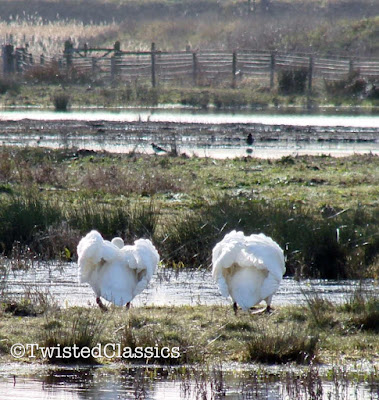
In another part of the marshes, two Mute swans were walking in tandem.
Saturday, 1 October 2016
A surfeit of white Egrets at Rainham Marshes
I have not seemed to have had much time to write blog posts just recently. I don't know why as I am retired and can do more-or-less what I want during the day, but the time just disappears. Anyway, I am now forcing myself to do so. At the end of August I visited the Rainham Marshes nature reserve. I got a train to Purfleet and walked for about 15 minutes along the path that runs along the Thames to the entrance of the reserve. It was a very hot day and, to my delight, there were lots of white Egrets at the edge of one of the lagoons. Unfortunately, they were too far away to take any decent photographs, but the picture below gives an idea of what I saw.
I have tried to enlarge the photo in order to identify what type of Egret it is - it may be the larger Great Egret as it seems to have dark coloured feet rather than yellow.
As I said earlier, the marshes seemed to be covered with white Egrets. Below are two more that were standing in another lagoon in front of another bird-watching hide. Here there were also Lapwings on view.
One of the white Egrets decided to march across the water and was obviously fishing for food.
In yet another small lagoon, there was another white Egret looking for its dinner.
In the picture below, there is one of them paddling in the water in a corner of the lagoon.
I am no bird expert, having only developed an interest in taking photographs of them in the last couple of years - due to having been given a reasonably good second-hand camera by my brother-in-law - so I am learning all the time. I believe these are Little Egrets, which have cute yellow feet, as can be seen on the flying white Egret in the photograph below.
In fact, there seemed to be white Egrets all over the marshes on that day. The photograph below was taken from one of the hides, which I sat in for a long time in order to get a break from the hot sun and to eat my lunch.
I have bought myself a bird reference book - Collins Bird Guide - which I have found to be very helpful, along with the internet, when trying to identify birds. The book gives the following information about Little Egrets: "Nests colonially in dense trees and bushes at shallow marshy lakes, rivers and coastal lagoons. Has recently colonised S England. Takes fish, frogs, insects, snails, etc. from shallow lakes, fish ponds, flooded fields and so on, often in small groups.
Identification: Medium-sized white heron, closer in size to Cattle Egret than to Great Egret, but slim and elegant. Black legs with sharply contrasting bright yellow toes. In flight, legs moderately projecting, wings look near centrally placed. Bill black; lores (part of the beak) blue-grey for greater part of the year."
In the photograph below, an Egret is taking off and has its lovely wings extended.
I have tried to enlarge the photo in order to identify what type of Egret it is - it may be the larger Great Egret as it seems to have dark coloured feet rather than yellow.
As I said earlier, the marshes seemed to be covered with white Egrets. Below are two more that were standing in another lagoon in front of another bird-watching hide. Here there were also Lapwings on view.
One of the white Egrets decided to march across the water and was obviously fishing for food.
In yet another small lagoon, there was another white Egret looking for its dinner.
It was a great day and I was absolutely thrilled to see so many white Egrets in the reserve. I only wish that I could have got much nearer to them so that I could have taken better photographs!
Labels:
birds,
egret,
egrets,
Great Egret,
lagoon,
lapwings,
Little Egret,
marshes,
nature,
nature reserve,
ornithology,
Rainham Marshes,
reeds,
wading birds,
White Egret,
wildlife
Friday, 26 August 2016
Oystercatchers and other waders in Musselburgh lagoons
Whilst in Edinburgh last week, I took two days off from the Festival in order to go bird-watching. One trip was to North Berwick in order to go on a boat trip round the Bass Rock and see the thousands of gannets that are on and around the rock at the moment - photographs of which are in one of my earlier posts. The second was an afternoon adventure to Levenhall Links nature reserve in Musselborough, which is on the coast between Edinburgh and North Berwick and easily reached by bus. In fact, I was going to see MacFloyd at an Edinburgh Fringe concert at Brunton Hall in Musselburgh in the evening, so that tied in nicely with a birding trip during the day.
The weather was a bit dull, but that did not stop me. What nearly stopped me was that the nature reserve, if going on foot from Musselburgh, is not that easy to find. It was easy to find the race-course, but the path to the reserve was at the back of the course and there were several dirt tracks and none of them were marked. I asked directions from a lady with a toddler and she sent me in completely the wrong direction. Then a very kind man who was walking his dog around the area, put me right and almost escorted me to the unmarked path through a field full of weeds and wild flowers that led to a lake and then the reserve.
After I had walked around part of the lake, I came to the entrance to the reserve - which was still unmarked. How you find it, if walking there, without the help of strangers, I do not know. Everyone I met in Scotland was very friendly and helpful, thank goodness.
There was a path that led to a concrete hide without a roof. There were several bird-watchers in the hide and I asked one of them if he could tell me what was on the site. Basically, it ended up that there was a path to the left that led to a second hide. This was at a dead-end, so you had to turn round and retrace your steps. There was also a path to the right that led to a third hide. This was also at a dead-end and you had to turn round and retrace your steps back to the centre hide. In front of the three hides, there were several lagoons.
According to Wikipedia, this is land reclaimed from the sea by building a sea wall and pumping large amounts of pulverised fuel ash into a number of ash lagoons. This infill site for fly ash from the coal-fired Cockenzie Power Station has been partially restored and landscaped. Shallow pools for wading birds have been created and the area has become a popular site for bird-watchers.
There were certainly a lot of wading birds in and around the lagoons - mainly hundreds of Oystercatchers, which I love. Unfortunately they were a long way away from the hide, so impossible to get good photographs of them. The photo below was at maximum zoom. There are also brown waders in the lagoon, which are probably Redshanks. I was told by the other bird-watchers in the hide that Curlew Sandpipers and Greenshanks were also there - but I do not have a scope and, as I was really in Scotland for the Edinburgh Festival and not bird-watching, I had only a small pair of binoculars with me. One man very kindly let me look through his scope, which he set up to let me look at a Redshank and a rarer Ruff, and seeing both birds together was great.
In the photo below, the hill that is called Berwick Law is in the background. This is located in North Berwick and can be clearly seen from many places around Edinburgh.
At least I managed to take photographs of some of the huge number of Oystercatchers that were hanging around the lagoons and, of course, it was much easier to find my way out of the nature reserve than it had been to find my way in. Also, going to the MacFloyd concert afterwards was so mind-blowing after the peace-and-quiet in the reserve!
The weather was a bit dull, but that did not stop me. What nearly stopped me was that the nature reserve, if going on foot from Musselburgh, is not that easy to find. It was easy to find the race-course, but the path to the reserve was at the back of the course and there were several dirt tracks and none of them were marked. I asked directions from a lady with a toddler and she sent me in completely the wrong direction. Then a very kind man who was walking his dog around the area, put me right and almost escorted me to the unmarked path through a field full of weeds and wild flowers that led to a lake and then the reserve.
After I had walked around part of the lake, I came to the entrance to the reserve - which was still unmarked. How you find it, if walking there, without the help of strangers, I do not know. Everyone I met in Scotland was very friendly and helpful, thank goodness.
There was a path that led to a concrete hide without a roof. There were several bird-watchers in the hide and I asked one of them if he could tell me what was on the site. Basically, it ended up that there was a path to the left that led to a second hide. This was at a dead-end, so you had to turn round and retrace your steps. There was also a path to the right that led to a third hide. This was also at a dead-end and you had to turn round and retrace your steps back to the centre hide. In front of the three hides, there were several lagoons.
According to Wikipedia, this is land reclaimed from the sea by building a sea wall and pumping large amounts of pulverised fuel ash into a number of ash lagoons. This infill site for fly ash from the coal-fired Cockenzie Power Station has been partially restored and landscaped. Shallow pools for wading birds have been created and the area has become a popular site for bird-watchers.
There were certainly a lot of wading birds in and around the lagoons - mainly hundreds of Oystercatchers, which I love. Unfortunately they were a long way away from the hide, so impossible to get good photographs of them. The photo below was at maximum zoom. There are also brown waders in the lagoon, which are probably Redshanks. I was told by the other bird-watchers in the hide that Curlew Sandpipers and Greenshanks were also there - but I do not have a scope and, as I was really in Scotland for the Edinburgh Festival and not bird-watching, I had only a small pair of binoculars with me. One man very kindly let me look through his scope, which he set up to let me look at a Redshank and a rarer Ruff, and seeing both birds together was great.
In the photo below, the hill that is called Berwick Law is in the background. This is located in North Berwick and can be clearly seen from many places around Edinburgh.
At least I managed to take photographs of some of the huge number of Oystercatchers that were hanging around the lagoons and, of course, it was much easier to find my way out of the nature reserve than it had been to find my way in. Also, going to the MacFloyd concert afterwards was so mind-blowing after the peace-and-quiet in the reserve!
Sunday, 26 June 2016
Moorhen chicks in the reeds
During a recent sunny visit to Barnes Wetland Centre, I saw a Moorhen family in the reeds. There were two really strange looking Moorhen babies with bald red patches on their heads and black fluff on their bodies.
At this stage in their lives, the tiny chicks really do look like a couple of aliens.
I can't remember if the Moorhen below was part of the family, but it looks very nice with a strange reflection in the lagoon.
![]() |
| Parent Moorhen with 2 chicks |
![]() |
| 2 Moorhen chicks in the reeds |
![]() |
| Moorhen swimming in the lagoon |
Thursday, 16 June 2016
Moorhen chick walks the plank
Last week I visited the Barnes Wetland Centre and, for a change, it stayed hot and sunny all day. I came across a Moorhen family - a parent and a chick were preening whilst standing on a piece of wood while the other chick was hiding behind them in the reeds.
The parent Moorhen was still in preening mode and a chick was now walking the plank - just look at it's super huge feet!
The parent and a chick were still standing on the branch. The other chick had taken the plunge and was happily swimming around in the lagoon.
![]() |
| Preening Moorhen parent and 2 chicks |
![]() |
| Moorhen preening and chick walking the plank |
![]() |
| Moorhen and chick on piece of wood while other little chick goes swimming |
Labels:
Barnes Wetland Centre,
birds,
chicks,
lagoon,
London wetlands,
london wildlife,
moorhen,
moorhen chicks,
nature,
ornithology,
reeds,
waterbirds,
waterfowl,
wetlands,
wildlife
Thursday, 14 April 2016
Heron nesting amongst the reeds – a nature lesson for me
![]() |
| Distant heron standing in the reed bed |
![]() |
| Heron and Coot on nests, with water-skiing Mallard |
I knew that a nearby coot was on a nest but, only when I downloaded my photographs onto the computer, did I realise that the heron was standing on it’s own nest. I was really surprised to discover this as I thought that herons only nested at the top of trees. While I was watching, a mallard was having a water-skiing session along the water in front of it.
![]() |
| Heron standing on nest in the reeds |
![]() |
| Heron on nest in the reeds |
![]() |
| Heron tending to it's nest in the reed bed |
![]() |
| Heron on water-based nest, plus reflection |
That day I learnt that herons do, sometimes, nest on the ground or, in this case, it looks as though it is nesting in the water!
Labels:
Barnes Wetland Centre,
bird,
birds,
duck,
heron,
lagoon,
London wetlands,
london wildlife,
Mallard,
nature,
nature photography,
ornithology,
reeds,
wetlands,
wildlife,
wildlife photography,
wildside
Subscribe to:
Posts (Atom)